
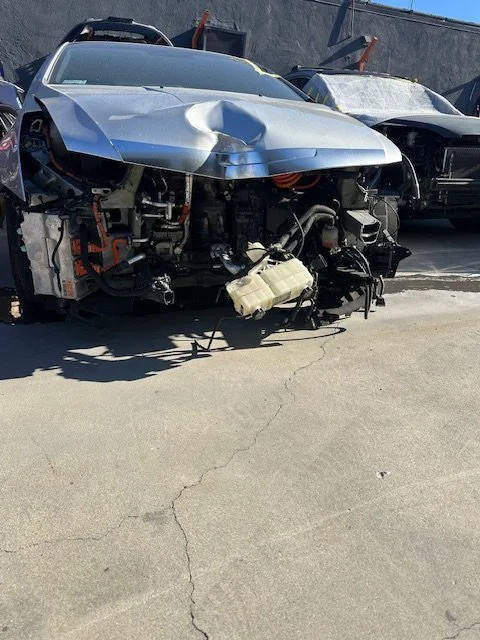
Look at the hood on this Cadillac. The dent is deep enough to catch your eye from across the parking lot. Now look below it. With the bumper cover out of the way, you can see wiring, hoses, and mounting points that would normally be hidden. That’s where the question “Is it totaled?” starts to get interesting.
A photo can show where to look. To know whether a car is a total loss, you need to know what it would take to repair it properly and what the car was worth just before the crash.
The first estimate may change
On a front-end hit like this, we’d check behind the visible damage for bent supports, shifted mounting points, and damage to cooling components or wiring. Depending on the vehicle, the estimate may also need to include diagnostic scans, structural measurements, or camera and radar calibrations. On an electric vehicle, the inspection may include checking high-voltage components as directed by the manufacturer.
Some of that work only becomes clear once parts come off. If the shop finds additional collision damage, it documents what it found and submits a revised estimate to the insurer. That’s why a car that initially looks repairable can end up being declared a total loss.
What was the car worth before the crash?
The insurer weighs the estimated repair cost against the vehicle’s pre-accident actual cash value. In California, that generally means fair market value unless the policy defines it differently. The vehicle’s trim, mileage, options, and condition can all affect that figure. The insurer may also consider salvage value, which is what the damaged car could sell for as it sits.
Imagine a car worth $20,000 before the crash. The initial estimate comes in at $11,000. After disassembly, hidden damage brings the estimate to $17,000. If the damaged car could sell for $4,000, the insurer may find it more economical to settle the claim as a total loss. Those numbers are an example. The Cadillac’s outcome would depend on its own inspection, estimate, and valuation.
What to ask if your car is declared a total loss
Ask for the repair estimate and the vehicle valuation report. Check that the report lists the right trim, mileage, and options, and look at the comparable vehicles used to set the value. If something is missing or incorrect, point it out to the adjuster and ask how it affects the offer.
If you’re dealing with collision damage in West Los Angeles, Culver City, or Mar Vista, contact Hilton Auto Collision Center. We can walk you through the repair estimate and explain what the damage means so you know what to ask your insurer.
California Department of Insurance consumer guidance on total losses and vehicle value