
Matte Paint on Modern Vehicles: Beautiful, Distinctive—and Difficult to Repair
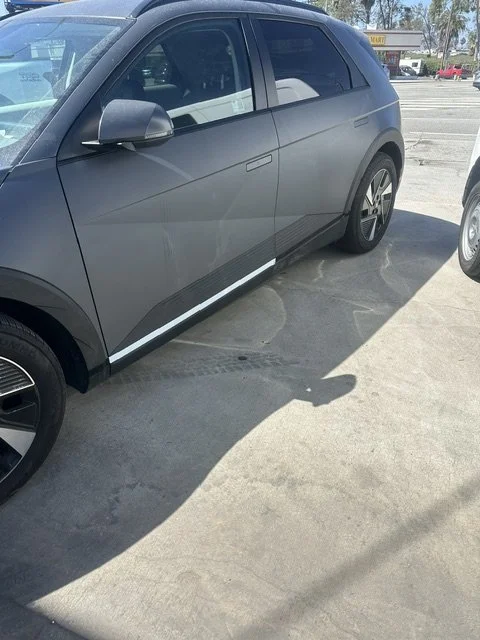
Matte and satin automotive finishes have become increasingly popular on modern luxury, performance, and electric vehicles. Colors such as matte gray can give a vehicle a sophisticated, distinctive appearance that stands out from conventional glossy paint.
But there is something every vehicle owner should understand: matte paint requires special care, and repairing it after a collision requires considerably more precision than repairing a traditional glossy finish.
At Hilton Auto Collision Center, we recently dealt with exactly this challenge on a 2025 Hyundai IONIQ 5 finished in matte gray. Replacing a damaged body panel isn't simply a matter of ordering the part, painting it gray, and installing it. The repaired area has to match both the color and the sheen of the surrounding factory finish.
Why Matte Paint Is So Difficult to Match
With conventional automotive paint, technicians concentrate heavily on matching color and metallic orientation. Once the clearcoat is applied, minor imperfections can often be corrected by sanding and polishing.
Matte paint changes the equation.
The painter has to reproduce not only the correct color but also the correct degree of matte or satin appearance. Spray technique, temperature, film thickness, flash time, gun settings and the number of coats can influence the final appearance.
A panel can therefore have the correct paint formula and still look different from the panel next to it.
That is why professional spray-out cards and careful evaluation under different lighting conditions are so important before the vehicle is painted.
Blending Is More Complicated
On a conventional finish, when a new door is installed, the color may be blended into the adjacent panels to create an invisible transition.
A matte vehicle presents an additional challenge. The painter cannot simply approach the clearcoat like conventional glossy clear and then polish the transition afterward.
Once a matte finish is polished, its appearance can change permanently, producing a shiny area that stands out against the surrounding finish.
Depending on the paint manufacturer's specified refinishing system, achieving a proper repair can therefore require refinishing complete panels rather than attempting a traditional localized clearcoat blend.
The objective isn't merely to make the color match. The texture and sheen must match as well.
Keeping Matte Paint Clean Is Different Too
Matte finishes also require different maintenance.
Traditional waxes, compounds and polishing products designed to increase gloss generally should not be used on matte paint. Automatic car washes that use aggressive brushes, waxes or gloss-enhancing chemicals can also be problematic.
Bird droppings, tree sap, bugs, grease and other contaminants should be removed promptly and carefully because allowing them to remain on the surface can make correction difficult.
And here's one of the biggest differences: you generally can't polish away a scratch or blemish the way you can on conventional clearcoat.
With glossy paint, an experienced detailer may be able to wet-sand and polish certain surface defects. On matte paint, doing that can create a shiny spot—which may look worse than the original defect.
Collision Repair Is More Than Replacing Parts
Today's vehicles are increasingly sophisticated. The same is true of their finishes.
A body shop repairing a matte-finished vehicle needs to understand the paint manufacturer's procedures, perform proper color and sheen matching, prepare spray-out cards, control application carefully and understand which adjacent panels need to be blended or completely refinished.
A technically correct repair should look like the accident never happened.
That's especially challenging with matte paint, because even a small difference in gloss level can make an otherwise excellent repair immediately noticeable.
At Hilton Auto Collision Center, our goal isn't simply to replace damaged parts. It's to return the vehicle as closely as possible to its pre-accident appearance and condition.
When it comes to matte paint, experience, preparation and attention to detail make all the difference.